
How to Become a Mentalist
The Advice I Wish Somebody Had Given Me Before I Bought My First Trick
If somebody asked me what it's like to start learning mentalism today, I'd probably give them an answer they weren't expecting.
I'd tell them it's a bit like arriving in the Wild West.
There are no signposts telling you where to begin. No recognised curriculum to follow. No governing body deciding which books are worth reading or which products deserve your attention. Every week another creator releases a download claiming to change the way you'll perform forever, while social media fills your feed with demonstrations that look impossible and promises that sound irresistible. For someone taking their first steps into mentalism, it's exciting, but it can also be overwhelming.
 Learning mentalism can be overwhelming.
The irony is that we've never had access to more information than we do today, yet I don't believe it's ever been harder to know what you should actually study. The problem isn't a shortage of material; it's a shortage of direction. Beginners often mistake buying for learning, watching for understanding and collecting methods for developing genuine ability. I've made every one of those mistakes myself, and if there's one thing I've learned after more than twenty years in mentalism, it's that becoming a mentalist has very little to do with how many secrets you know.
It has everything to do with how you learn to think.
Before you buy another trick, download another tutorial or convince yourself that the next purchase will finally be the one that changes everything, I'd like to offer a different perspective. This isn't a list of the best books to read or the greatest tricks to learn first. It's simply the advice I wish somebody had given me when I was standing where you are now, trying to work out what mentalism really was and, more importantly, what kind of mentalist I wanted to become.
One of the reasons I think so many people struggle to learn mentalism is because nobody ever really stops to explain what they're trying to learn in the first place. We throw around words like mind reading, psychology, influence and body language as though everybody understands what they mean, but mentalism is much more difficult to define than that. In fact, if you asked ten experienced performers to describe it, you'd probably receive ten slightly different answers.
For me, mentalism has always been a performance art. It's the ability to create the believable illusion that you can read thoughts, influence decisions or demonstrate extraordinary abilities of the human mind. Those demonstrations may rely on psychology, observation, suggestion, deception, intuition or any number of theatrical techniques, but none of those things define mentalism on their own. They're simply tools. Mentalism is what happens when those tools are brought together with purpose, experience and a genuine understanding of the emotional journey you're taking your audience on.
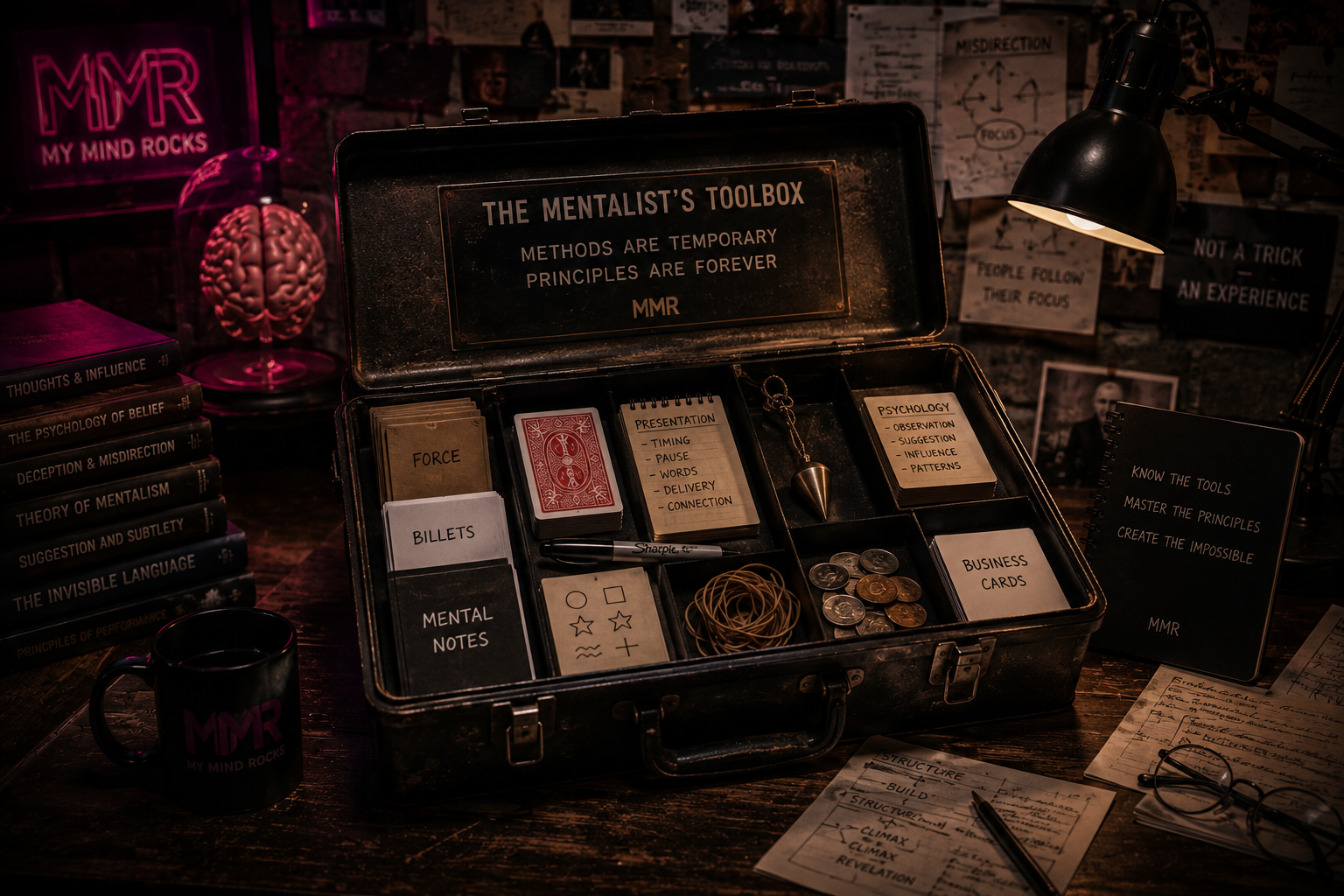
That's an important distinction because beginners often become fascinated by the tools before they've fallen in love with the art itself. They spend months learning how to force a word, glimpse a billet or influence a decision without ever asking themselves the more important question: why am I doing this? If your answer is simply, "Because it's clever," you've already started walking down the wrong path.
The methods themselves are only ever there to support an experience. Nobody remembers a great mentalist because they executed a perfect centre tear or an invisible billet switch. Audiences remember how they felt. They remember the impossible coincidence, the private thought that somehow became public or the prediction that shouldn't have been possible. Long after they've forgotten the details, they'll remember the feeling that, just for a few moments, they experienced something they couldn't quite explain.
That's the real product of mentalism. It isn't the method. It isn't the prop. It isn't even the effect. It's the feeling you leave behind.
Once you begin looking at mentalism through that lens, something changes. You stop obsessing over collecting secrets and start paying much closer attention to presentation, timing, language and human behaviour. You begin asking different questions. Instead of wondering, "How does this work?" you find yourself asking, "Why does this have such a powerful impact on people?" In my experience, that's one of the first signs that somebody is beginning to think like a mentalist rather than simply learning mentalism.
If I had to identify the single biggest reason people stop progressing in mentalism, it wouldn't be a lack of talent. It wouldn't be a lack of money and it certainly wouldn't be a lack of information. More often than not, it's because they become trapped in a cycle that feels productive without actually moving them forwards.
It usually begins with genuine enthusiasm. A new book arrives through the post and you can't wait to read it. You discover a creator whose work really resonates with you and before long you've bought three more of their releases. Someone recommends another download on a forum, then another appears on YouTube, and before you know it you're consuming more mentalism than ever before. It feels like you're learning because you're constantly surrounded by new ideas.
The uncomfortable truth is that consuming information and developing ability are two very different things.
I've met performers with shelves of books who rarely perform, and I've met others with only a handful of well-worn books who have become exceptional mentalists. The difference has very little to do with the size of their library. It comes down to what they did with the information once they had it.
One idea, explored properly, is almost always worth more than twenty ideas that are quickly forgotten.
That's one of the reasons I encourage people to slow down. If you discover a routine that genuinely excites you, don't immediately move on to the next chapter. Sit with it. Ask yourself why it works. Think about how you would present it. Consider whether it suits your character, whether it fits the audiences you perform for and whether the underlying principle might be applied somewhere else entirely. The more time you spend asking questions like these, the more valuable every book and every lecture becomes.
It's also worth remembering that there is no prize for owning the biggest collection of mentalism. I know performers who have spent thousands of pounds chasing the next miracle, convinced that the next purchase would somehow unlock the level they wanted to reach. Most eventually discover what experienced mentalists have known for years: the breakthrough rarely comes from buying something new. It comes from understanding something you already own.
That's why I often describe mentalism as a toolbox rather than a collection. Every principle you genuinely understand becomes another tool you can call upon when you need it. A billet technique isn't a routine; it's a tool. A force isn't an effect; it's a tool. A psychological subtlety isn't something to be admired in isolation; it's another way of solving a performance problem. Over time you stop thinking in terms of tricks and begin thinking in terms of possibilities. Instead of asking, "What shall I perform next?" you begin asking, "How can I create the experience I want my audience to have?"
Looking back, I don't think the best investment I ever made was buying another trick. It was investing time in understanding the principles behind the tricks I already owned. That simple shift changed the way I thought about mentalism, and once the way you think begins to change, the way you perform usually follows.
One of the easiest things to do when you're learning mentalism is to become captivated by somebody else's performance. You watch a lecture, buy the book, learn the routine and before you know it you're repeating their words, copying their timing and trying to recreate the reactions you watched on the screen. We've all done it to some extent. It's part of the learning process, and in the beginning there's nothing wrong with borrowing ideas while you develop your own understanding.
The problem comes when borrowing becomes permanent.
Spend enough time around an online mentalism community and you'll eventually recognise the same performances wearing different jackets.The methods may be excellent, the scripting polished and the reactions impressive, but underneath it all you're often watching one performer's interpretation of another performer's interpretation of somebody else's original idea. Somewhere along the line, the individual disappeared.
I've held an opinion for a long time that not everyone agrees with.
I think ninety per cent of mentalists aren't actually mentalists.
Now, before that statement upsets anyone, let me explain what I mean.
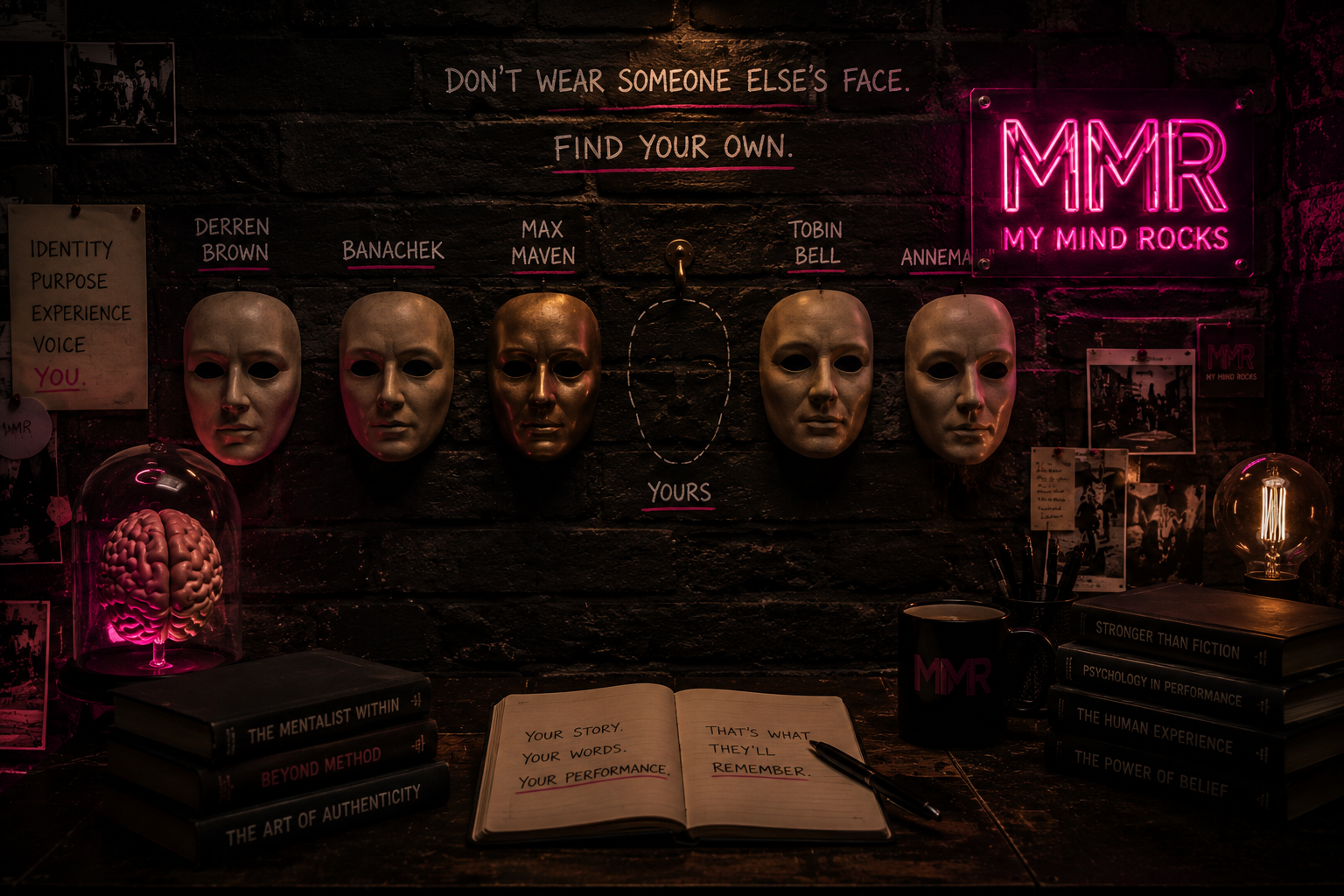
I'm not questioning anybody's ability, their knowledge or their right to call themselves whatever they choose. I'm talking about identity. Too many performers spend their careers demonstrating effects without ever stopping to ask what they're really trying to communicate. They become brilliant at presenting somebody else's version of mentalism rather than discovering what their own version might look like.
Ask ten people to define mentalism and you'll probably receive ten different answers. Some lean heavily into psychology, others into suggestion or intuition. Some embrace mystery, while others distance themselves from anything that could be mistaken for the paranormal. None of those approaches are inherently right or wrong. They're simply different interpretations of the same art form, and that's exactly how it should be.
The important thing is that your interpretation is genuinely yours.
If every performance you give could be lifted out of another performer's show without anyone noticing, you've got some work to do. Your audiences aren't looking for the next Derren Brown, Banachek or Max Maven. They already have those. Whether they realise it or not, they're looking for someone authentic. They want to spend an hour in the company of a performer who believes every word they're saying and presents ideas that feel consistent with who they are.
That takes time.
It also takes confidence, because finding your own voice usually means letting go of the safety net that comes with copying other people. It's far easier to repeat a script that's already proven successful than it is to write one of your own. It's easier to perform somebody else's structure than to trust your own instincts. Yet the performers who leave the biggest impression are almost always the ones who eventually stop asking, "How would they perform this?" and start asking, "How would I perform this?"
I don't believe originality means inventing entirely new methods. Very few of us will ever do that. Originality comes from the way you combine ideas, the way you speak, the stories you choose to tell and the experiences you've had that nobody else has. Two performers can use exactly the same method and create completely different pieces of theatre because they bring different personalities to the performance. That's where originality lives.
If I could give one piece of advice to anyone starting out, it would be this: don't be in a hurry to become somebody else. Learn from the performers you admire. Study their thinking, understand why their material works and appreciate the contribution they've made to the art. Then put the books back on the shelf, close the laptop and spend some time working out what you want to say.
Because in the end, people won't remember you for the methods you used.
They'll remember you for the performer you became.
Mentalism can be a surprisingly lonely pursuit.
Most hobbies are easy to share with other people. If you enjoy golf, cycling or photography, chances are you'll know somebody nearby who shares your interest. Even if you don't, you'll have no difficulty finding a local club or community where people are only too happy to welcome newcomers.
Mentalism is different.
We're a niche within a niche. Depending on where you live, you could spend years without meeting another person who shares your fascination with psychological entertainment. You might have family and friends who are supportive, but it's difficult for them to understand why you've spent an entire evening thinking about a single line of script, or why changing the order of two sentences suddenly makes a routine feel so much stronger.
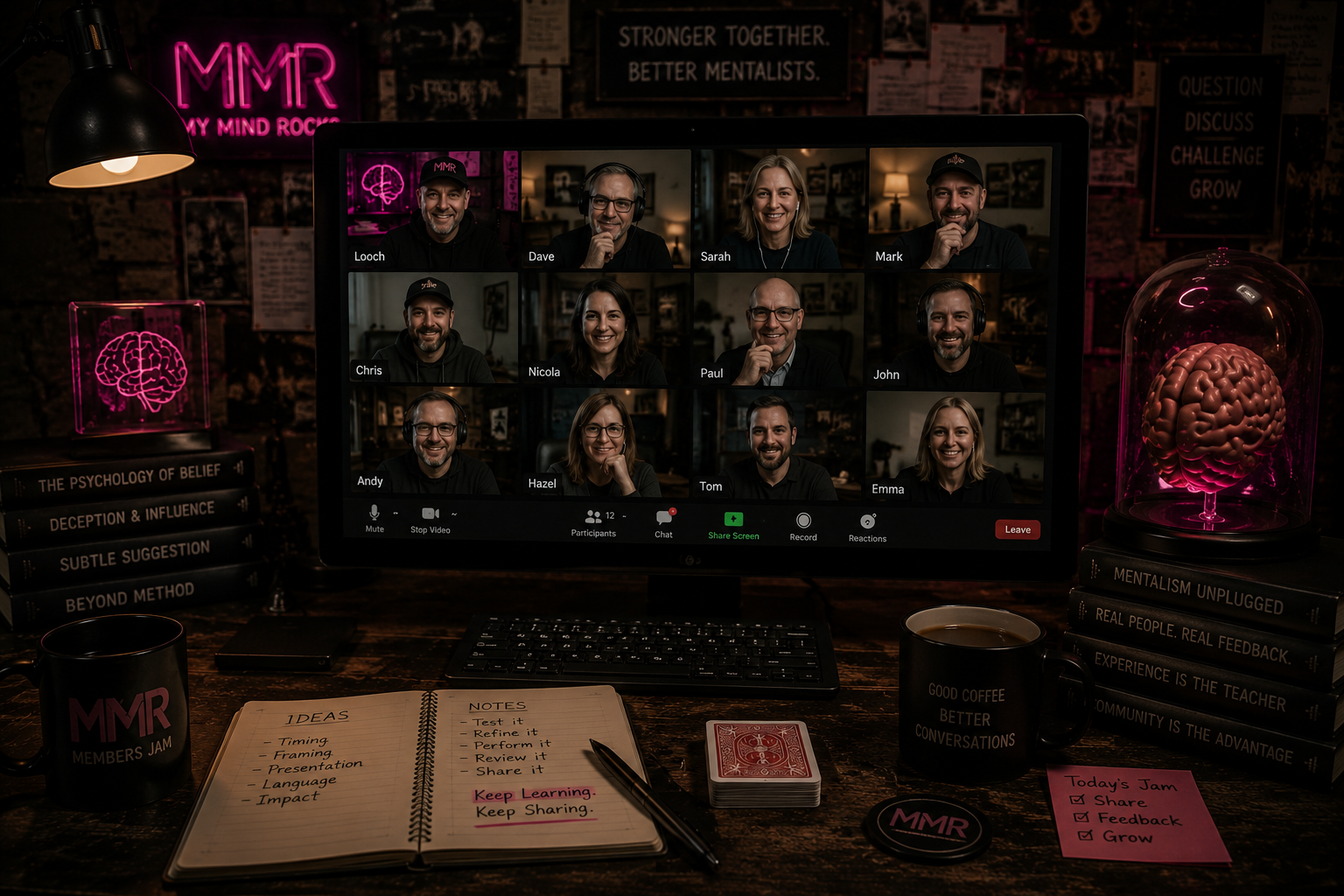
That isolation can become one of the biggest obstacles to improving.
When you're learning on your own, without an online mentalism community to exchange ideas with, every decision feels like a guess. Is this presentation any good? Am I heading in the right direction? Is there a better way of approaching this? Without honest feedback, it's easy to become trapped inside your own thinking. Sometimes you'll convince yourself an idea is brilliant when it isn't. Other times you'll abandon something with enormous potential simply because nobody encouraged you to keep exploring it.
I've lost count of the number of times a casual conversation with another mentalist has completely changed the way I think about a routine. Not because they taught me a better method, but because they asked a question I'd never considered. Sometimes a five-minute conversation can achieve more than five hours spent reading on your own.
That's something beginners often overlook. The real value of being around experienced performers isn't that they hand you secrets. It's that they help you think more clearly. They challenge your assumptions, spot weaknesses you can no longer see and occasionally remind you that you're making life much harder than it needs to be.
The same is true the other way around. Some of the most interesting ideas I've encountered over the years haven't come from seasoned professionals; they've come from enthusiastic newcomers who weren't yet constrained by convention. One of the things I love most about mentalism is that good ideas don't care how long you've been performing. Experience gives you perspective, but curiosity often produces the breakthrough.
If there's one lesson I've learned over the years, it's that none of us grows in isolation. Every performer I admire has been influenced by conversations, friendships and the generosity of people who were willing to share their thinking. That's one of the reasons proper crediting matters so much in mentalism. Our art has always evolved by building on the work of those who came before us, and acknowledging that lineage isn't just respectful - it's part of understanding where our ideas came from.
Looking back, I realise that many of the biggest leaps in my own development happened after talking with other performers rather than sitting alone with another book. Those conversations challenged my thinking, exposed weaknesses in my performances and occasionally sent me back to routines I'd dismissed years earlier. They reminded me that mentalism isn't simply a collection of techniques; it's an ongoing conversation between people who care deeply about the art.
That's why I believe finding your tribe and becoming part of a supportive mentalism community is one of the most important decisions you'll make as a mentalist. Not because they'll tell you what to think, but because they'll encourage you to think more deeply. They'll celebrate your successes, question your ideas, keep you grounded when necessary and remind you that every performer, no matter how experienced, is still learning.
The irony is that many people spend years searching for the next great secret when what they really need is a great conversation.
That belief in learning from one another is ultimately what led me to create My Mind Rocks. Over the years, I've learned just as much from conversations with other mentalists as I have from books, lectures and performances. I wanted to create somewhere those conversations could happen regularly, where people at different stages of their journey could share ideas, ask questions, experiment and learn from one another. That's what we've been building at MMR, and it's been wonderful to see how much people can achieve when they're willing to get involved.
There comes a point where every mentalist has to make a decision.
You can carry on reading books, watching lectures and refining your scripts in the comfort of your own home, or you can step in front of another human being and discover whether any of it actually works.
There's no substitute for that moment.
It's easy to convince yourself a routine is perfect when the only audience you've ever performed it for is the bathroom mirror. It's much harder when you're standing in front of a real person who wasn't expecting to become part of your experiment. Suddenly the pauses feel different. The jokes don't always land where you imagined they would. The instructions you thought were crystal clear turn out to be anything but. What looked flawless on paper becomes something entirely different in the real world.
That's not failure.
That's education.
Every performance tells you something the books never could. You begin to recognise the moments where people lose interest, the words that create confusion and the lines that genuinely connect. You learn how long to hold a silence, when to move on, when to trust an audience and, just as importantly, when not to. None of those lessons can be fully understood by reading about them. They have to be experienced.
One of the biggest misconceptions I see is the belief that performers reach a point where everything simply works. The truth is far less glamorous. Even after years of performing, you'll still leave a show replaying moments in your head, wondering whether a different choice of words might have made something stronger or whether a routine could be tightened by thirty seconds. That process never really ends, nor should it. The moment you believe you've got nothing left to improve is probably the moment your development stops.
When I look back at my own career, I don't remember the routines that worked perfectly. I remember the ones that didn't. I remember the awkward moments, the unexpected interruptions and the performances where something completely unforeseen forced me to think on my feet. At the time they felt frustrating. Looking back, they were some of the most valuable lessons I ever received because they taught me adaptability rather than repetition.
That's another reason I encourage people not to become obsessed with methods. A method can fail. A prop can be forgotten. A spectator can react in a way you never anticipated. When you've spent years building a genuine understanding of mentalism rather than simply memorising routines, you become far more resilient because you're no longer dependent on everything unfolding exactly as it did in the instructions.
There's an old saying that experience is something you get just after you needed it. Mentalism has a habit of proving that true on a regular basis. Every audience leaves you a little wiser than the last one, provided you're prepared to listen. The performers who improve the fastest aren't necessarily the ones who perform the most. They're the ones who reflect on their performances honestly, identify what could be better and then have the discipline to make those improvements before stepping in front of the next audience.
If you spend enough time performing, something interesting begins to happen. You stop concentrating so hard on yourself and start paying much closer attention to the people standing in front of you. Your focus shifts away from remembering the next line or worrying about the next move and towards understanding the audience's reactions, their personalities and the subtle differences that make every performance unique. In my opinion, that's another milestone in becoming a mentalist. The performance stops being about you and starts becoming about them.
That's where real confidence comes from. Not because you know every outcome in advance, but because you've developed enough experience to cope when life inevitably refuses to follow the script.
It's very easy to spend so much time thinking about what you're going to perform that you never stop to think about who you're becoming as a performer.
At first glance that might sound like an odd distinction, but I think it's one of the most important questions you'll ever ask yourself.
Every routine you choose, every book you study and every performance you give gradually shapes the kind of mentalist you become. That process often happens without you even noticing. One day you realise you've developed a particular style, a way of speaking and an approach to audiences that feels completely natural. The danger is that if you never consciously think about it, somebody else may end up making those decisions for you.
I've always believed that audiences are far more interested in authenticity than perfection.
They don't expect you to be flawless.
They expect you to be believable.
That's why I think character is so important in mentalism. Whether your performances lean towards psychology, intuition, influence or mystery doesn't really matter. What matters is that your audience believes you believe it. They don't need to agree with your premise, but they do need to feel that it's genuine. Authenticity creates trust, and trust is what allows an audience to suspend their disbelief long enough to experience something extraordinary.
This is one of the reasons I encourage people not to rush. There's a temptation, particularly in the age of social media, to measure your progress against everyone else. You see another performer releasing a new project, appearing on television or posting clips that attract thousands of views, and it's easy to feel as though you're falling behind.
You're not.
You're simply watching somebody else's journey.
The only comparison that really matters is between the performer you were six months ago and the performer you are today. Have your presentations become stronger? Are your audiences reacting more deeply? Do you understand the art a little better than you did last year? Those are the questions worth asking because they're the only ones you can genuinely influence.
One thing I've noticed over the years is that the performers who enjoy the longest and most rewarding careers are rarely the ones chasing every new trend. They're the ones with a clear sense of who they are and what they want their audiences to experience. Trends come and go. New methods appear every week. Fashions change. A strong identity survives all of them.
I also think it's important to remember that becoming a mentalist isn't a destination you eventually reach. There isn't a moment where somebody hands you a certificate and says, "Congratulations, you've finished learning." If anything, the opposite is true. The more you study the subject, the more you realise how much there is still to discover. That's one of the reasons I love mentalism as much today as I did when I first started. It continues to surprise me. It continues to challenge me. Even now I'm still changing my opinions, refining my performances and discovering ideas that make me look at the art from a completely different perspective.
I hope that never changes.
Because the day you stop being curious is probably the day you stop growing.
If you've read this far, I suspect you're not looking for shortcuts. You're looking for understanding. You don't simply want to know how a routine works; you want to know why it works. You want to become a better performer rather than just a better collector of methods.
If that's true, then you're already asking the right questions.
And in my experience, asking the right questions has always been a far better place to start than chasing the right answers.
If you've read this far, I hope you've realised that becoming a mentalist isn't about finding the perfect book, buying the latest release or discovering a method nobody else knows. Those things all have their place, but they're only ever small pieces of a much bigger picture.
Mentalism is a lifelong study.
The more you immerse yourself in it, the more you realise there isn't a finish line waiting somewhere in the distance. Even after more than twenty years, I'm still learning. I'm still changing my opinions, refining presentations, questioning ideas I once believed and discovering principles that make me see the art in a completely different light. That's one of the reasons I love mentalism as much today as I did when I first started. Every answer seems to lead to another question, and every performance teaches me something I didn't know the day before.
If I could offer one final piece of advice, it would simply be this.
Don't measure your progress by the number of books you've read, the tricks you've bought or the lectures you've watched. Measure it by the quality of your thinking. Measure it by the conversations you've had, the audiences you've performed for and the confidence you've developed in your own ideas. Those are the things that quietly shape you into a better performer, even if they don't always feel as exciting as opening the latest parcel or downloading the newest release.
Most importantly, don't try to become somebody else.
The world doesn't need another copy of your favourite mentalist. It needs performers who are prepared to think for themselves, develop their own voice and contribute something meaningful to an art that has always evolved through curiosity, generosity and a willingness to keep learning.
That's why I created My Mind Rocks.
Not because I believed the world needed another website full of tutorials, but because I wanted to build the kind of community I would have loved to be part of when I was finding my own way through mentalism. A place where questions are encouraged, ideas are explored, experience is shared and people genuinely want to see one another improve. Somewhere that values principles over purchases, discussion over dogma and long-term development over quick fixes.
Whether you've never performed a single routine or you've been standing in front of audiences for decades, I believe we all have something left to learn and something worthwhile to contribute. That's what makes this community so rewarding. Every member arrives with different experiences, different opinions and different ambitions, yet we're all connected by the same fascination with this extraordinary art.
If that sounds like the kind of environment you've been looking for, I'd love to welcome you into the My Mind Rocks community. We'll continue asking questions, challenging assumptions and exploring mentalism together.
Because in the end, becoming a mentalist isn't about reaching a destination.
It's about never losing your curiosity.
Mentalism isn't something you finish learning. It's something you spend a lifetime understanding.